The Future of Artificial Intelligence: Where Is the World Heading?
Artificial Intelligence (AI) is no longer a concept confined to science fiction movies. It is here, evolving at a breakneck pace, and fundamentally reshaping how we live, work, and interact with the world. But what exactly is the future of AI? How does it work behind the scenes, and what are the ultimate benefits and risks for humanity?
If you have ever wondered where the world is heading in the age of intelligent machines, you are in the right place. Let's dive deep into the mechanics, the miracles, and the potential menaces of AI.
(Note: Replace the image path with your actual Next.js public folder image path)
How Does AI Actually Work? The Science Behind the Magic
To understand the future, we must first understand the present. AI is essentially the simulation of human intelligence processes by machines, especially computer systems. But it doesn't "think" like we do; it calculates.
Here is a breakdown of the core technologies driving AI today:
Machine Learning (ML): Instead of programming a computer step-by-step to do a task, we give it a massive amount of data and let it find patterns. For example, show an ML model a million pictures of cats, and it learns to identify a cat on its own.
Deep Learning & Neural Networks: Inspired by the human brain, deep learning uses artificial neural networks with multiple layers. This is the technology powering advanced voice assistants, self-driving cars, and highly realistic image generation.
Natural Language Processing (NLP): This allows AI to understand, interpret, and generate human language. It is the engine behind ChatGPT, Gemini, and your website's customer service chatbots.
In short, AI works by consuming massive amounts of data, analyzing it for patterns, and using those patterns to make predictions or decisions about future data.
Where Is the World Heading? The AI Revolution
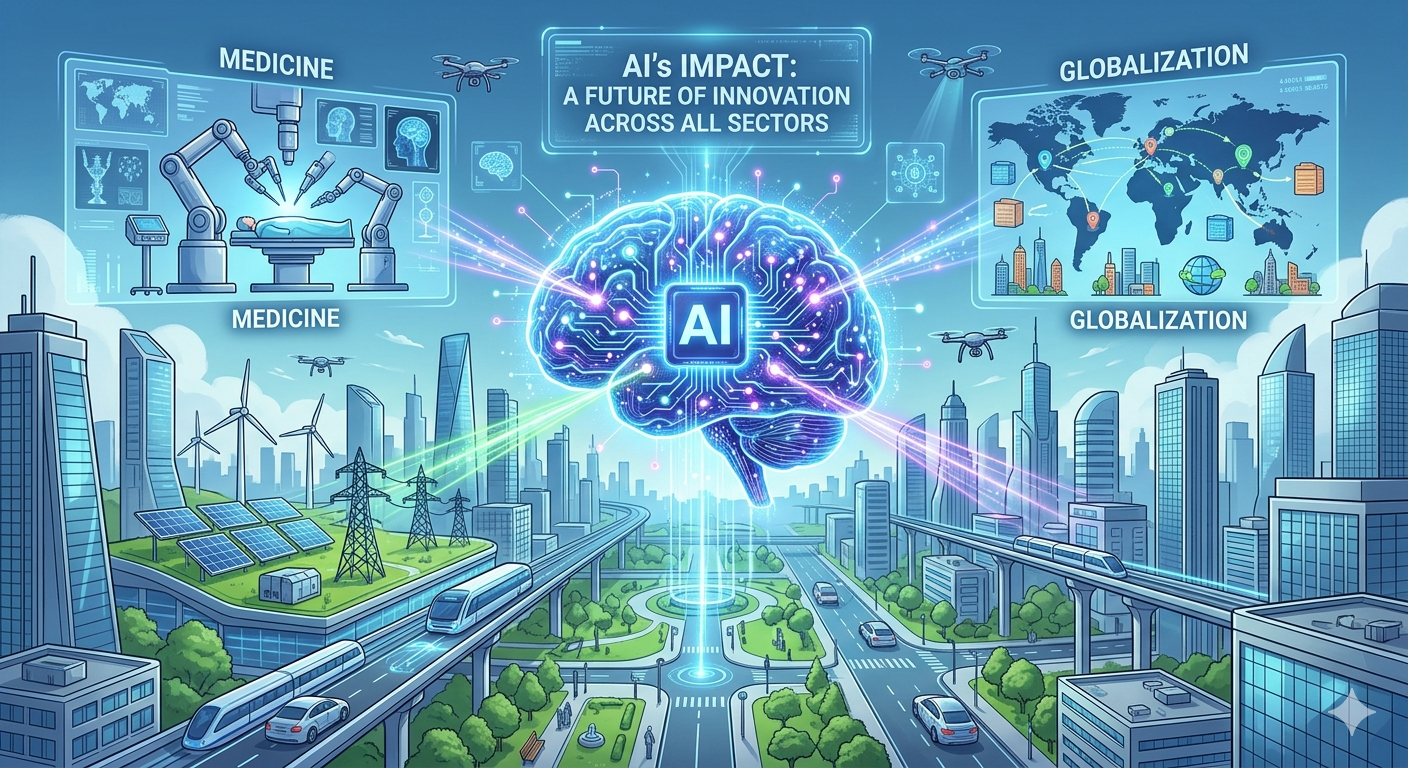
The world is rapidly moving toward an era of hyper-automation and seamless human-machine collaboration.
Right now, we are in the stage of Narrow AI (AI that is highly capable in one specific task, like playing chess or generating text). The future holds the pursuit of AGI (Artificial General Intelligence)—a machine that possesses human-like cognitive abilities across all fields.
In the next 10 to 20 years, we will see:
- Smart Cities: AI managing traffic lights in real-time to eliminate jams, optimizing energy grids, and predicting infrastructure failures before they happen.
- Personal AI Companions: Highly personalized AI assistants that know your habits, manage your schedule, monitor your health, and even tutor your children.
- The Metaverse and Web3: AI will generate dynamic virtual worlds on the fly, tailoring entertainment and digital workspaces to individual preferences.
How AI Will Help Humanity (The Benefits)
The positive impact of AI could be unprecedented in human history. Here is how AI is poised to help us:
1. Medical Breakthroughs and Healthcare
AI can analyze X-rays and MRIs faster and more accurately than human radiologists. It is already being used to discover new drugs in months rather than decades, and personalized medicine will soon allow treatments tailored to your exact DNA.
2. Solving Complex Global Issues
AI models can process massive climate datasets to predict extreme weather events, optimize renewable energy distribution, and design new, eco-friendly materials to combat climate change.
3. Automating the Mundane
By taking over repetitive and dangerous tasks—from data entry to deep-sea welding—AI frees up humans to focus on creative, strategic, and emotionally intelligent pursuits.
4. Accessible Education
AI-driven tutors can adapt to a student's unique learning speed and style, providing personalized education to children in remote parts of the world who lack access to traditional schools.
The Dark Side: Potential Risks and Threats (The Dangers)
While the benefits are massive, the rapid advancement of AI brings significant risks that society must address immediately.
1. Job Displacement
As AI becomes capable of writing code, creating art, and analyzing legal documents, many white-collar and blue-collar jobs are at risk. While new jobs will be created, the transition could cause severe economic inequality and massive unemployment if not managed properly.
2. Deepfakes and Misinformation
AI can now generate hyper-realistic videos and audio of real people saying things they never said. In a world heavily reliant on digital media, this threatens to destroy trust in news, manipulate elections, and ruin reputations.
3. Bias and Discrimination
AI is only as good as the data it is trained on. If historical data contains human biases (e.g., racism, sexism), the AI will inherit and amplify those biases in critical areas like hiring, lending, and law enforcement.
4. Security and Existential Threats
There is a growing concern about AI being used to develop autonomous weapons (lethal autonomous weapons systems) or orchestrate massive cyberattacks. Furthermore, some top scientists warn that an uncontrolled AGI could eventually view humanity as an obstacle, posing an existential threat.
Conclusion: Striking the Balance
The future of AI is not inherently good or bad—it is a mirror of our own intentions. It is the most powerful tool humanity has ever created. It can cure diseases and solve the climate crisis, but it can also disrupt economies and weaponize information.
The ultimate destination of the world depends on how we regulate, build, and interact with AI today. By focusing on ethical AI development, robust safety protocols, and continuous learning, we can ensure that AI becomes humanity's greatest ally rather than its downfall.
**What are your thoughts on the AI revolution? Are you excited or worried? Let us know in the comments below!