The Ultimate Guide to Full-Stack Web Development in 2026: Crucial Considerations and Choosing the Right Tech Stack
Being a full-stack developer in today's fast-paced digital ecosystem is no longer just about knowing HTML, CSS, JavaScript, and a bit of database management. It is about becoming a digital architect. You are responsible for the user interface, the server logic, the database performance, and the cloud deployment.
When you sit down to build a robust web application, the sheer number of decisions can be overwhelming. What database should you use? Should you render on the client or the server? Which language is best for your specific use case?
In this comprehensive guide, we will break down the essential factors every full-stack developer must consider before writing a single line of code, and we will provide a detailed roadmap on which programming languages and frameworks are best suited for specific types of websites.
Part 1: Crucial Considerations Before Developing a Website
Before you open your code editor, you need a blueprint. Failing to plan is planning to fail. Here are the core architectural and structural aspects you must deeply consider.
1. Understanding Business Logic and Scalability
The very first question you must ask is: What is the ultimate goal of this application?
Are you building a simple portfolio, or are you building the next Uber?
- Vertical vs. Horizontal Scaling: If your app goes viral, how will it handle a million users? Will you just buy a bigger server (Vertical scaling), or will you distribute the load across multiple smaller servers (Horizontal scaling)? Your architecture must support your choice.
- Microservices vs. Monolith: For an MVP (Minimum Viable Product), a single monolithic codebase is usually best. However, for massive enterprise apps, breaking the app into smaller, independent services (Microservices) might be necessary later on.
2. The Security-First Mindset
Security cannot be an afterthought; it must be baked into the foundation.
- Authentication & Authorization: How will users log in? Will you use JWT (JSON Web Tokens), OAuth 2.0 (Login with Google/GitHub), or traditional session cookies?
- Data Validation: Never trust the client. Always validate data on both the frontend (for UX) and the backend (for security) to prevent SQL Injections and XSS (Cross-Site Scripting) attacks.
- CORS & CSRF: Ensure your API only accepts requests from trusted origins and implement tokens to prevent Cross-Site Request Forgery.
3. Database Architecture: SQL vs. NoSQL
Choosing the wrong database can haunt you for years.
- Relational (SQL - PostgreSQL, MySQL): Use this when your data is highly structured and relationships matter. For example, in an e-commerce app, a user has many orders, and an order has many products. SQL is perfect for maintaining strict data integrity.
- Non-Relational (NoSQL - MongoDB, Firebase): Use this for unstructured data, rapid prototyping, or applications where read/write speeds are critical, like real-time analytics or chat histories.
4. Frontend Rendering Strategies
Since you are using modern tools like Next.js, you have multiple ways to deliver HTML to the browser:
- CSR (Client-Side Rendering): Great for highly interactive dashboards hidden behind a login screen.
- SSR (Server-Side Rendering): Crucial for dynamic data that needs perfect SEO (like a news site).
- SSG (Static Site Generation): Best for blogs or documentation where content rarely changes. It is the fastest rendering method.
5. Deployment and CI/CD
How does code go from your local machine to the live server? Setting up a Continuous Integration and Continuous Deployment (CI/CD) pipeline using GitHub Actions ensures that every time you push code, it is automatically tested and deployed securely.
Part 2: Choosing the Right Tech Stack for the Right Project
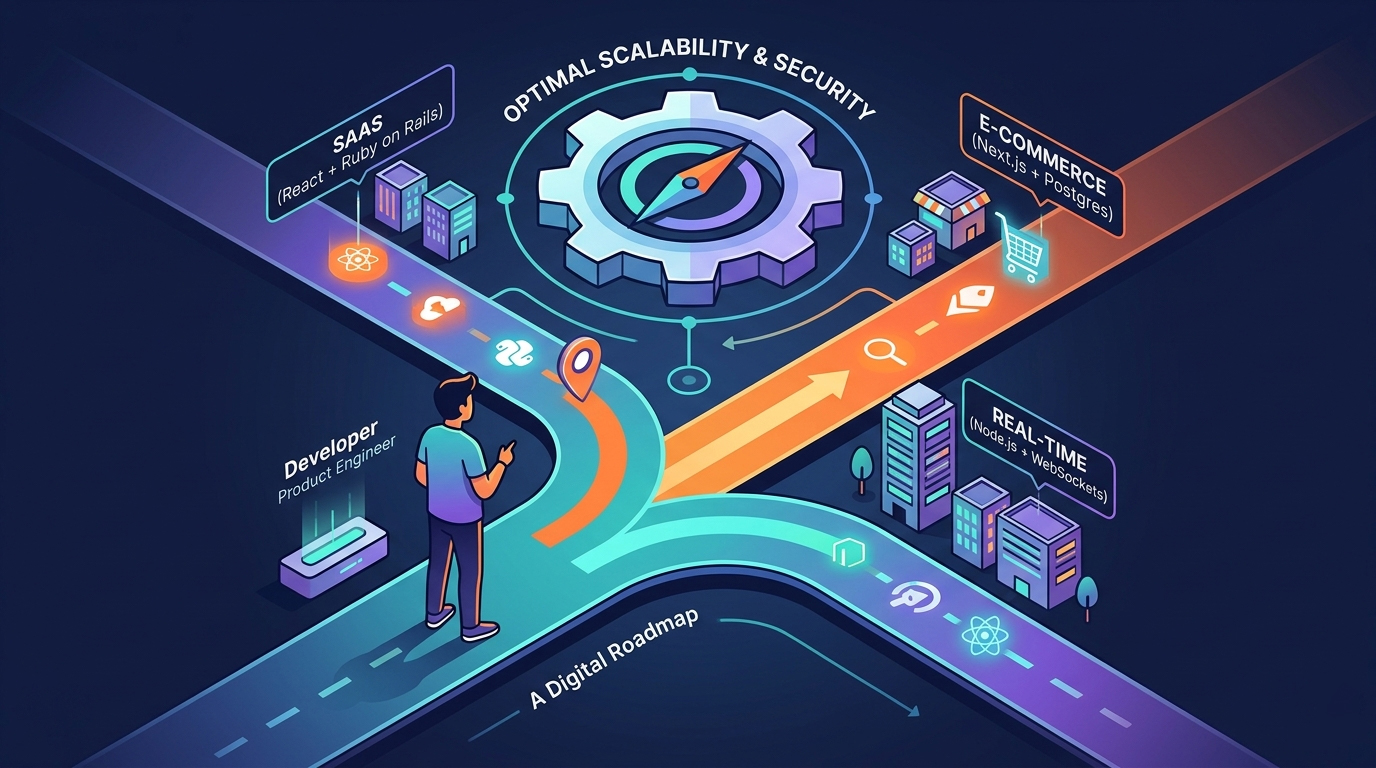
Now for the million-dollar question: Which language and framework should you use? The truth is, there is no "best" language. There is only the "best tool for the job." Let's break down the most common types of web applications and the ideal tech stacks for them.
1. E-Commerce Platforms (High Traffic, Complex Transactions)
E-commerce sites need high security, robust database relations, and excellent SEO.
- The Best Stack: React/Next.js (Frontend) + Node.js or Python/Django (Backend) + PostgreSQL (Database).
- Why? Next.js handles the SEO and fast page loads beautifully using Server-Side Rendering (SSR). PostgreSQL strictly handles the complex relationships between users, carts, payments, and inventory without data corruption. Node.js handles thousands of concurrent requests smoothly, while Django provides built-in admin panels and high security out of the box.
- Alternative: Shopify Plus or Magento (PHP) if you want a dedicated CMS rather than a custom build.
2. SaaS (Software as a Service) Applications
SaaS products (like Trello, Slack, or Canva) require complex state management, user roles, and subscription billing.
- The Best Stack: React or Vue.js (Frontend) + Node.js/Express or Ruby on Rails (Backend) + PostgreSQL + Redis (Caching).
- Why? You need a highly reactive UI, which React or Vue provides. Ruby on Rails is famous for developer happiness and speed, allowing you to launch an MVP incredibly fast. Node.js is great if your team wants to use JavaScript everywhere. Redis is essential for caching user sessions and speeding up database queries.
3. Real-Time Applications (Chat Apps, Live Streaming, Trading Dashboards)
If your application requires data to update instantly without the user refreshing the page, traditional request-response cycles won't work.
- The Best Stack: JavaScript/TypeScript (Frontend) + Node.js or Go (Golang) (Backend) + WebSockets / Socket.io + MongoDB or Cassandra.
- Why? Node.js is built on an event-driven, non-blocking architecture, making it the absolute king of handling thousands of simultaneous WebSocket connections (like a chat room). Go (Golang) is also an incredible choice here due to its raw performance and native concurrency (Goroutines).
4. Content-Heavy Websites (Blogs, News Portals, Corporate Sites)
Here, SEO is king. The content must load instantly, and the site must rank #1 on Google.
- The Best Stack: Next.js or Astro (Frontend) + Headless CMS (Sanity, Strapi, WordPress Headless) + CDN (Vercel, Cloudflare).
- Why? You do not need a complex custom backend for a blog. Using Next.js for Static Site Generation (SSG) means your site loads in milliseconds. Connecting it to a Headless CMS allows writers to publish content easily, while you maintain complete control over the frontend design.
5. Enterprise and FinTech (Banking, High-Security Corporate Software)
When millions of dollars are on the line, performance, strict typing, and bulletproof security are mandatory.
- The Best Stack: Angular (Frontend) + Java (Spring Boot) or C# (.NET Core) (Backend) + Oracle or SQL Server.
- Why? Startups love JavaScript, but banks love Java and C#. These languages are strongly typed, heavily tested, and extremely reliable. The Spring Boot (.NET) ecosystems have decades of enterprise-grade security libraries built into them. Angular is often preferred on the frontend because of its strict, opinionated structure, which is great for massive developer teams.
6. Quick MVP (Minimum Viable Product) / Prototyping
You have an idea, and you need to get it to market in two weeks to test it with real users.
- The Best Stack: Laravel (PHP) or Django (Python) or Supabase (Backend-as-a-Service).
- Why? These are "batteries-included" frameworks. They come with built-in authentication, database routing, email verification, and security middleware. You don't have to glue five different libraries together; you just start building your business logic immediately.
Part 3: Deep Dive into Backend Languages in 2026
To be a master full-stack developer, you need to know the strengths of the backend languages at your disposal.
**JavaScript / TypeScript (Node.js)**
- Pros: You can use one language for the entire stack (MERN stack). Massive community, endless NPM packages, great for real-time apps. TypeScript adds the much-needed type safety.
- Cons: Single-threaded (though worker threads exist), which makes it poor for CPU-intensive tasks like video encoding or heavy machine learning.
**Python (Django / FastAPI)**
- Pros: Incredible syntax, very easy to read. It is the absolute standard for AI, Machine Learning, and data analysis. If your web app uses AI, Python is almost mandatory.
- Cons: Slower execution speed compared to compiled languages like Go or Rust.
**PHP (Laravel)**
- Pros: Despite the old jokes, modern PHP (v8+) is incredibly fast and robust. The Laravel framework offers the best developer experience on the market. Great for rapid development.
- Cons: Synchronous by nature, not the best fit for highly real-time, event-driven applications compared to Node.js.
**Go (Golang) and Rust**
- Pros: The future of high-performance backend development. They offer C-level speed with modern memory safety (especially Rust). Perfect for microservices, cloud infrastructure, and handling massive network traffic.
- Cons: Steeper learning curve. Slower development time for simple CRUD applications compared to Python or PHP.
Conclusion: The Mindset of a Master Developer
Ultimately, a great full-stack developer is language-agnostic. They do not fight over whether React is better than Vue, or Python is better than Node.js. Instead, they look at the project requirements—budget, timeline, scale, and team expertise—and choose the right tools for the job.
As you build your next project, remember to focus on the fundamentals: write clean code, design a scalable database, prioritize the user experience, and secure your endpoints. Technologies will change, frameworks will fade, but solid software architecture principles will last forever.
*What tech stack are you planning to use for your next big project? Have you ever chosen the wrong database and regretted it later? Share your experiences in the comments below!